
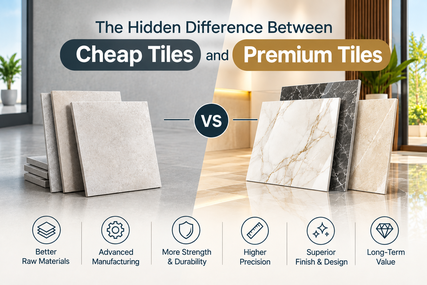
When choosing tiles for a home, office, showroom, hotel, or commercial space, price is often one of the first things people compare. Two tiles may look almost identical at first glance, yet their prices can be significantly different.
So, what makes one tile cheaper while another is considered premium?
The difference is not always visible on the surface. It can be found in the raw materials, manufacturing process, strength, surface quality, dimensional accuracy, finish, durability, and long-term performance.
Understanding these hidden differences can help you choose tiles based on value rather than simply the lowest price.
How to Choose Tiles Based on Lighting in Your Room
Quality of Raw Materials
One of the biggest differences between economical and premium tiles is the quality and consistency of the raw materials used during manufacturing.
Premium tiles generally require carefully selected and processed raw materials to achieve consistent strength, density, colour, and surface quality. Lower-cost tiles may be manufactured with materials or formulations optimized primarily for cost.
The quality of the raw materials can affect the tile’s appearance, durability, water absorption, and overall performance.
Manufacturing Technology
Tile manufacturing involves several stages, including mixing, pressing, drying, glazing or surface treatment, printing, and firing.
Premium tile manufacturers may use advanced production equipment and carefully controlled processes to maintain consistency across batches.
Modern digital printing technology, for example, can create more realistic stone, marble, wood, or decorative patterns. Advanced surface treatments can also produce specific finishes such as glossy, matte, structured, or polished surfaces.
The manufacturing process therefore plays an important role in determining both the appearance and performance of a tile.
Strength and Durability
A tile is not just a decorative product—it also needs to withstand the conditions of the space where it is installed.
Tiles used in areas such as living rooms, kitchens, commercial spaces, corridors, parking areas, and outdoor locations may experience regular foot traffic, impact, moisture, stains, or temperature changes.
Premium tiles are often designed and manufactured with performance characteristics suitable for their intended application. Choosing the correct tile type and technical specifications is therefore more important than choosing based only on appearance or price.
Water Absorption and Application
Not every tile is suitable for every location.
Different tile categories have different technical characteristics, including water absorption. A tile selected for a bathroom, exterior wall, kitchen, living room, or heavy-traffic commercial area should be appropriate for that application.
Instead of asking only, “Which tile is cheaper?”, ask:
“Is this tile technically suitable for where I want to use it?”
A cheaper tile that is unsuitable for the application can create additional costs through repairs, replacement, or maintenance.
Better Design and Technology
Premium tiles often provide more than basic colours and patterns.
Manufacturers can use technologies such as digital printing and advanced surface treatments to reproduce the appearance of natural materials and create sophisticated decorative effects.
This can include:
- Marble and stone-look designs
- Wood-look finishes
- High-definition patterns
- Textured surfaces
- Glossy and matte finishes
- Large-format designs
- Special decorative effects
These design technologies can help create a more distinctive and visually consistent interior.
Quality Control
Quality control is another hidden factor behind tile pricing.
Manufacturers may inspect tiles for dimensions, surface defects, shade variation, flatness, and other technical parameters before products reach the market.
A strong quality-control process helps reduce inconsistencies and ensures that products meet their intended specifications.
This is one reason why two tiles that appear similar in a showroom can have different prices.
Installation and Long-Term Value
The initial purchase price is only one part of the total cost of a tile project.
Consider the complete cost:
Tile + Adhesive + Installation + Maintenance + Repairs + Replacement
A low-priced tile may appear attractive initially, but if it has poor dimensional consistency, unsuitable technical properties, or a finish that does not perform well in its intended environment, the overall cost can increase.
A higher-quality tile that performs well for many years may provide better long-term value, depending on the application.
Cheap vs. Premium Tiles: What Should You Compare?
Instead of comparing tiles only by price per square foot, consider these factors:
| Factor | What to Check |
|---|---|
| Raw Materials | Quality and consistency |
| Strength | Suitability for expected usage |
| Water Absorption | Appropriate for the installation area |
| Dimensions | Size and dimensional consistency |
| Surface | Finish, texture, and uniformity |
| Design | Printing quality and pattern variation |
| Shade | Batch and colour consistency |
| Quality Control | Manufacturing inspection standards |
| Application | Residential, commercial, indoor, or outdoor use |
| Long-Term Value | Maintenance and replacement considerations |
Final Thoughts
The difference between cheap and premium tiles is often hidden beneath what you can see in a showroom.
Raw materials, manufacturing technology, dimensional accuracy, surface finish, colour consistency, quality control, and technical performance can all influence the final price and the tile’s long-term value.